

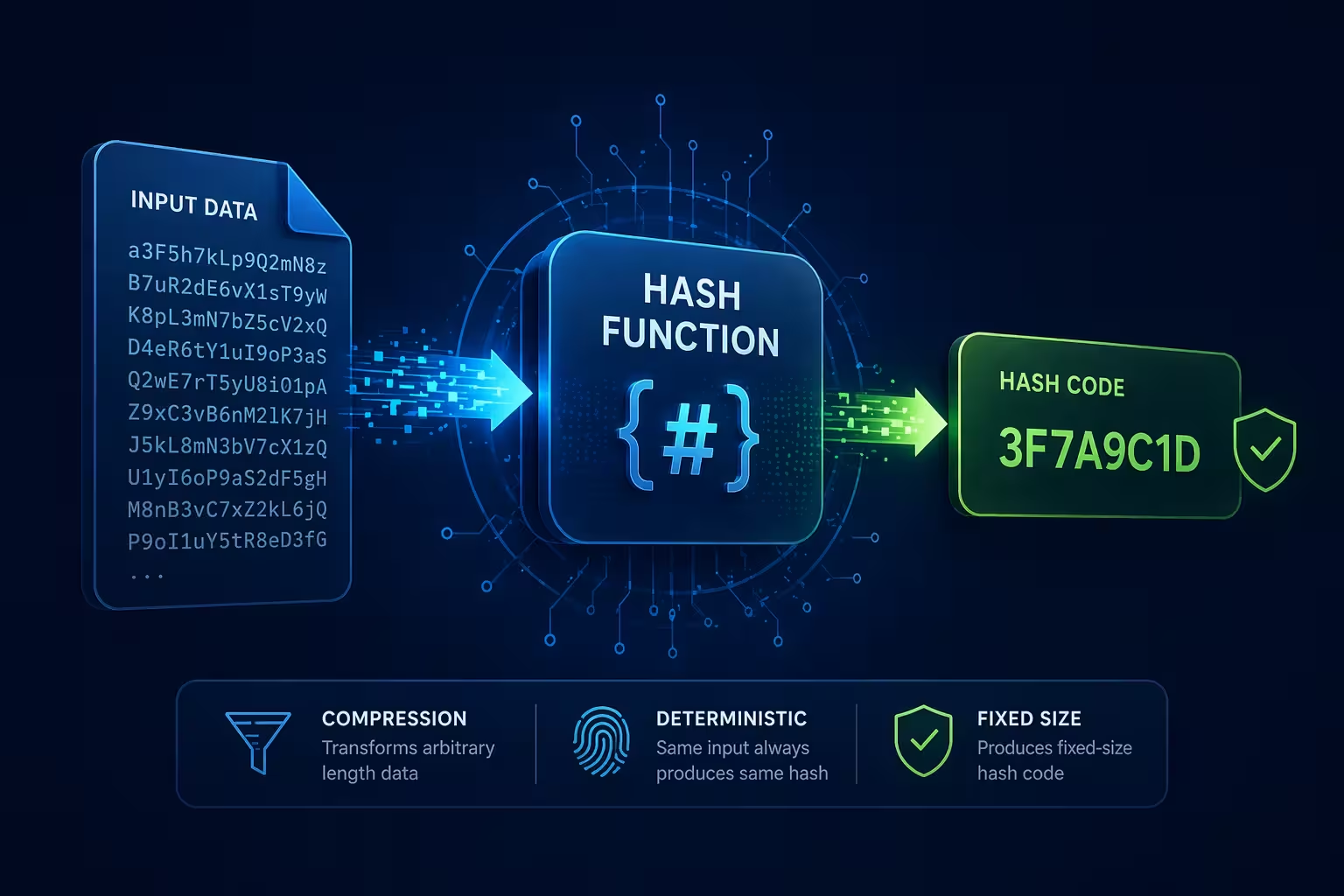
- Every piece of data—from a single word to a massive file—gets its own unique "fingerprint" that identifies it without revealing its content.
- High-security hash functions are designed to be impossible to reverse, which is why they are the gold standard for storing passwords safely.
- Without hash functions, there would be no secure internet, no Bitcoin, and no high-speed databases.
Have you ever wondered how a website knows your password is correct in a split second? Or how your computer finds one specific file out of millions almost instantly? It’s not just “being fast”—it’s a bit of mathematical sorcery called Hashing.
Think of a Hash Function as a high-tech “Blender.” You put something in—a word, a giant book, or a photo—and the blender spits out a tiny, unique digital fingerprint (a fixed string of numbers and letters).
1. What Exactly is a Hash Function?
In simple terms, a hash function takes an input of any size and turns it into a fixed-size code.
Imagine you have a giant library. Instead of memorizing every word in every book, you give each book a “secret code” based on its title. If the title is “The Cat in the Hat,” your code might be CH22. No matter how long the book is, the code is always short.
A Quick Example: The Modulo Method
Let’s say our “blender” rule is: Take a number and divide it by 10. The remainder is your code.
- You give it 25 Code is 5 (, remainder 5)
- You give it 100 Code is 0
- You give it 987,654 Code is 4
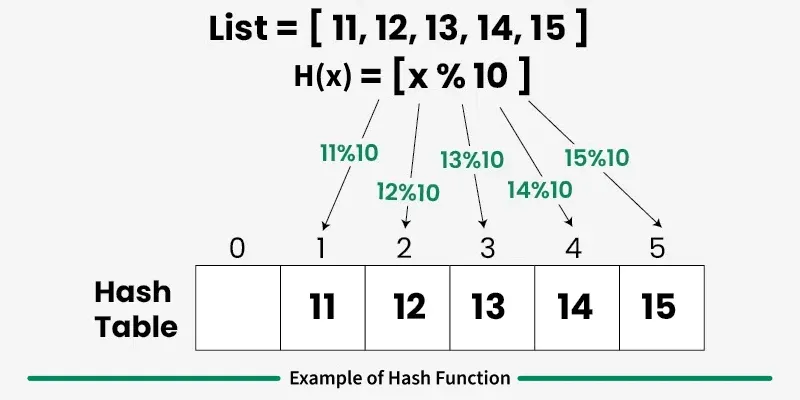
Boom! You just turned a massive number into a single digit. That’s hashing!
2. The “Golden Rules” of a Great Hash Function
To be useful, a hash function needs to be a bit of a perfectionist. Here are its five main personality traits:
- Deterministic (Reliable): If you hash the word “Pizza” today, it should give you the code
P123. If you do it tomorrow, it better still beP123. - Fast (Speedy): It shouldn’t take ten minutes to calculate a code. It needs to be nearly instant.
- The “Avalanche Effect”: If you change even one tiny thing—like changing “Pizza” to “pizza” (lowercase)—the entire code should look completely different.
- One-Way Only: You can turn “Pizza” into
P123, but you should never be able to look atP123and guess that it came from “Pizza.” It’s a secret! - No Collisions: It should be super rare for two different things (like “Apple” and “Banana”) to end up with the same code.
3. The Different “Blender” Recipes (Types)
Not all hashes are made the same way. Depending on what you need, you might use a different recipe:
- The Division Method: The simple “remainder” trick we did above. Great for quick tasks!
- The Mid-Square Method: You square a number ($10 \times 10 = 100$) and grab the middle digits. It’s like shuffling a deck of cards to make sure the numbers are spread out.
- The Folding Method: You chop a long number into pieces and add them together. It’s like folding a long piece of paper until it fits in your pocket.
- Cryptographic Hashes (The Bodyguards): These are the heavy hitters like SHA-256. They are used for Bitcoin and passwords because they are impossible to crack.
4. Where Do We Use This Magic?
Passwords
Websites are actually quite forgetful—on purpose! They don’t store your password. They store the hash of your password. When you log in, they hash what you typed and see if the “fingerprints” match. This keeps you safe if the website gets hacked.
The Blockchain
Ever heard of Bitcoin? The entire system relies on hashing. Each “block” of data is locked with a hash that connects to the previous block. If someone tries to change a single number, all the hashes break like a falling row of dominoes!
Fast Search (Hash Tables)
Imagine a giant warehouse with a billion boxes. Without hashing, you’d have to check every box. With hashing, the “code” tells you exactly which aisle and shelf to go to. $O(1)$ speed, baby!
5. Let’s Build One in Python!
Python makes hashing super easy. Here is a quick script to show you how a tiny change in a word creates a totally different “fingerprint.”
import hashlib

def create_fingerprint(text):
    # We'll use SHA-256, the same tech behind Bitcoin!
    return hashlib.sha256(text.encode()).hexdigest()

# Notice the tiny difference (Capital 'H' vs lowercase 'h')
print(f"Hash of 'Hello': {create_fingerprint('Hello')}")
print(f"Hash of 'hello': {create_fingerprint('hello')}")

# A simple "Division Method" example
def simple_hash(number, shelf_count):
    return number % shelf_count

print(f"Box 12345 goes to shelf: {simple_hash(12345, 10)}")
6. Summary: Why It Matters
Hash functions take the “messy” world of infinite data and organize it into neat, tiny, secure codes. Whether it’s protecting your bank account or helping you find a YouTube video, hashing is the invisible engine making the internet feel like magic.
References & Further Learning
- GeeksforGeeks: Introduction to Hashing
- Computerphile: Hashing Algorithms Explained (YouTube)
- Python Docs: The
hashlibLibrary
Hashing is just one piece of the puzzle. Whether you’re prepping for an interview or building the next big app, our Algorithm Index has everything you need to stay ahead.